
Tooth extraction leaves a gap behind, and not just in your mouth. It also leaves questions: when can I get an implant? Do I have to wait months? What if there is not enough bone? Implants after tooth extraction are currently the most reliable restoration method, but their success depends on many factors that are worth knowing before making any decision. This guide answers them all.
Table of contents
- Key points
- Implants after tooth extraction: what you need to know first
- Implant placement steps step by step
- Complications and how to avoid them
- Waiting time and placement options
- My perspective as a dentist
- Implant restoration at Drkasouhas Clinic
- Frequently asked questions
Key points
| Point | Details |
|---|---|
| Healing time | Soft tissues take 1-2 weeks to heal, but bone takes longer. |
| Immediate vs delayed implantation | The choice depends on bone quality and wound condition, not personal preference. |
| Choosing the right dentist | The surgeon's experience directly affects the avoidance of complications and the final result. |
| Post-operative care | Diet, hygiene, and avoiding smoking determine the success of osseointegration. |
| Completion time | From extraction to the final crown, the process can take 3 to 9 months. |
Implants after tooth extraction: what you need to know first
Before we talk about dates and procedures, there are some basic truths that determine whether or not an implant will be successful. The most common misconception is that every patient can have an implant placed immediately after extraction. In reality, immediate implantation is not always recommended and depends on an assessment of the patient’s condition.
Bone quality and quantity
Bone is the foundation of the implant. If there is not enough bone or if its density is low, the implant will not be properly stabilized. The dentist evaluates this with an x-ray or CT scan before deciding on the placement method. In cases of bone deficiency, a bone graft may be needed, which adds time to the treatment.
Soft tissue condition
The soft tissues around the extraction site must be healthy. If there is infection or inflammation at the time of extraction, immediate implant placement is not possible. The body needs time to calm down and create a safe environment for the new implant.
General health and risk factors
Certain medical conditions significantly affect the success of dental implants. Diabetes, osteoporosis, and smoking reduce the bone's ability to integrate the implant. Smoking in particular is one of the most important factors in failure. Patients taking anticoagulants or osteoporosis medications should inform their dentist before any surgery.
| Criterion | Demand |
|---|---|
| Amount of bone | At least 8-10 millimeters high and 5-6 millimeters wide |
| Gum condition | Absence of inflammation and infection |
| General health | Controlled chronic diseases |
| Oral hygiene | Good, without active periodontitis |
| Smoking | Discouragement or interruption before and after |
Pro tip: Always request a digital computed tomography (CBCT) scan before deciding on an implant. It provides a much more accurate picture of the bone than a simple X-ray and helps the dentist plan the procedure accurately.
Implant placement steps step by step
Placing an implant is not a single visit to the dentist. It is a process that unfolds in phases, and each phase has its own importance.
Phase 1: assessment and planning
The dentist will take a CT scan, evaluate your medical history, and discuss your options with you. At this stage, a decision is made as to whether immediate or delayed implantation will be performed and whether bone grafting is needed. This is the most critical step because it determines everything that follows.
Phase 2: the surgery
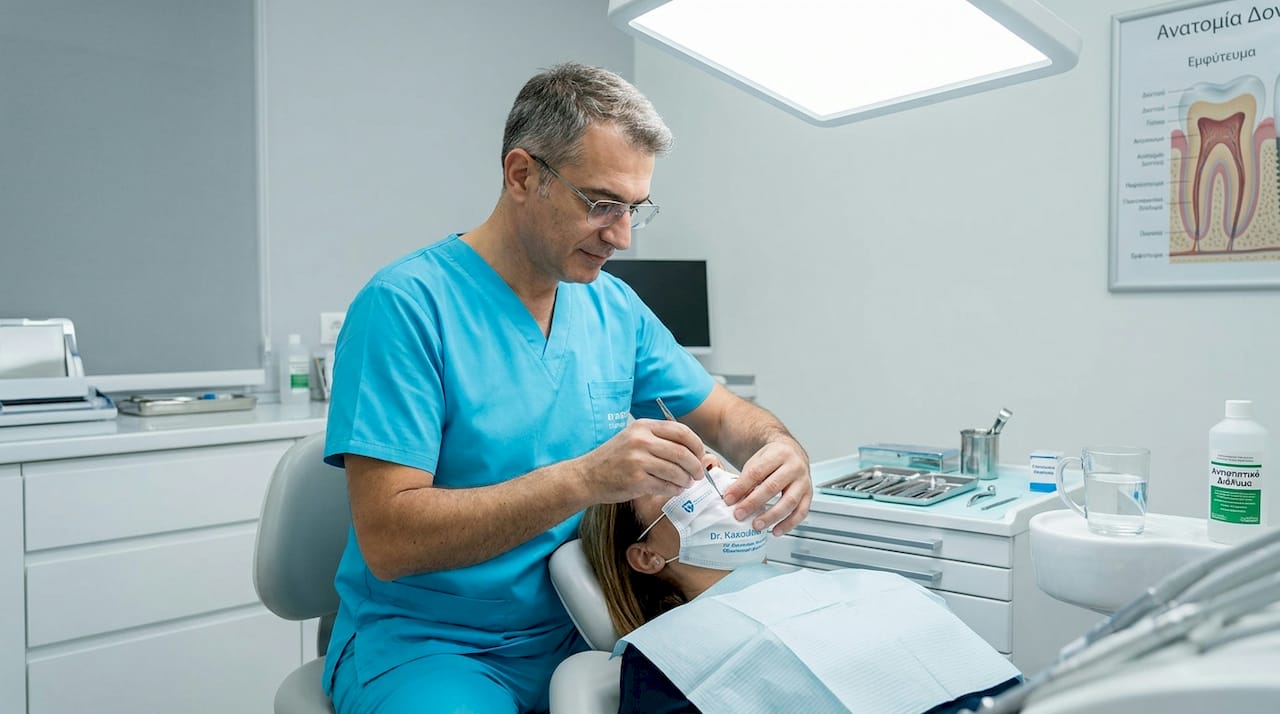
The placement is done under local anesthesia. The dentist makes a small incision in the gum, creates a hole in the bone, and places the titanium implant. The procedure usually takes 30 to 60 minutes per implant. After placement, the gum is sutured and the healing period begins.
Phase 3: osseointegration
This is the phase that requires patience. The titanium implant must “fuse” with the bone, a process called osseointegration. It usually takes 3 to 6 months, depending on the quality of the bone and the patient’s overall health. During this phase, the implant should not be subjected to high chewing forces.
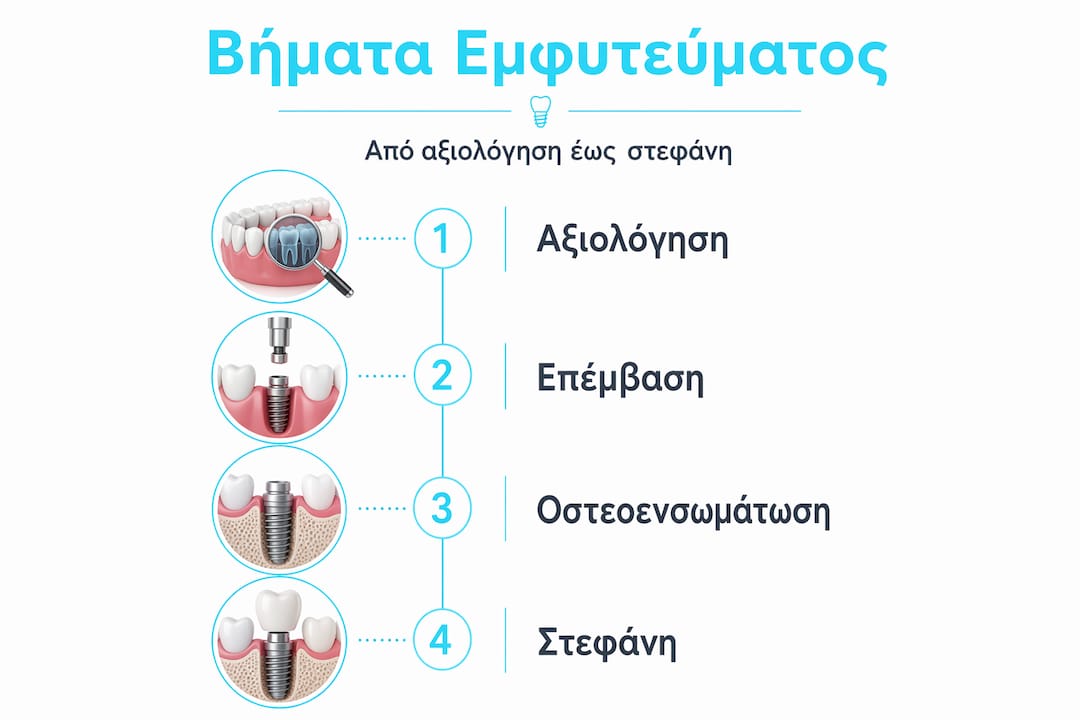
Phase 4: crown placement
Once osseointegration is complete, the dentist places the abutment and then the crown, which is the visible part of the artificial tooth. The crown is usually made of porcelain and matches the color of your natural teeth. At this point, the prosthetic restoration is complete.
| Phase | Description | Duration |
|---|---|---|
| Evaluation | Examinations, CT scan, planning | 1-2 visits |
| Surgery | Implant placement | 30-60 minutes |
| Osseointegration | Bone integration | 3-6 months |
| Prosthetic | Spacer and crown | 2-4 weeks |
Pro tip: During the osseointegration phase, ask your dentist for a temporary tooth. It’s not just a cosmetic issue. It helps to maintain the gap properly and prevent neighboring teeth from shifting.
Complications and how to avoid them
Complications after extraction and implantation are uncommon when the procedure is performed by an experienced surgeon. However, there are scenarios you should be aware of.
The most common side effects in the first few days after surgery are pain, swelling, and minor bleeding. These are normal and will subside in 3 to 5 days. If the pain persists or worsens after the third day, this is a sign that something is wrong.
Signs that require immediate contact with the dentist:
- Severe pain that does not subside with painkillers
- Fever above 38 degrees
- Visible swelling that is getting bigger instead of smaller
- Difficulty opening the mouth
- Bad smell or unusual taste at the site of the surgery
A serious infection after a dental procedure can result in a recovery cost of over 20,000 euros, not counting the pain and discomfort. Choosing an experienced dentist is not a luxury.
Proper self-care after surgery
Post-extraction care directly affects how quickly and well you heal. For the first 24 hours, avoid eating hard foods, smoking, or vigorously rinsing your mouth. From the next day, gentle saltwater rinses help keep the area clean without irritating the tissues.
Diet also plays a role. Soft foods like yogurt, soup, and pureed vegetables are ideal in the first few days. Avoid foods that require a lot of chewing or that are very hot, as they can cause bleeding or slow healing.
Waiting time and placement options
The question “when can I get an implant after extraction?” doesn’t have one answer. It has three, depending on the case.
The choice between immediate and delayed implantation depends on factors such as the condition of the wound, the quality and quantity of the bone. In some cases the implant is placed at the time of extraction, in others 3 months later.
Immediate implantation
The implant is placed on the same day as the extraction. This is only possible when there is no infection, the bone is sufficient, and the dentist considers that the conditions allow it. The advantage is the reduction in the overall treatment time. The disadvantage is that it is not suitable for everyone.
Early implantation
It is done 4 to 8 weeks after extraction, after the soft tissues have begun to heal. The bone has not yet been significantly resorbed, so there is a good foundation for the implant. This approach is suitable for cases where there was little inflammation at the time of extraction.
Delayed implantation
It is performed 3 to 6 months after extraction, after the bone has fully healed. It is the safest option for cases with severe infection, bone deficiency or complex anatomical conditions. It allows the dentist to plan the procedure more precisely.
| Method | Installation time | Advantages | Disadvantages |
|---|---|---|---|
| Direct | Same day with export | Fewer visits, faster results | It is not suitable for everyone. |
| Early | 4-8 weeks later | Good tissue healing, flexibility | Requires careful evaluation |
| Delayed | 3-6 months later | Greater safety, complete healing | Longest total time |
Pro tip: Don’t choose a method based on time or cost. Choose based on the condition of the bone and the opinion of an experienced implantologist. Rushing at this stage will cost you dearly later.
My perspective as a dentist
In my work, I often see patients who come in after an extraction with a single question: “When can I get an implant?” And while that is a perfectly reasonable question, the correct question is another: “What is the best option for my case?”
I have seen patients who pushed for immediate implantation without meeting the requirements, and then experienced implant failure requiring reoperation. I have also seen patients who waited too long, resulting in significant bone loss and the need for a graft.
What works best in practice is an individualized approach. There is no “typical” patient. A 45-year-old nonsmoker with good health and adequate bone has very different needs than a 60-year-old diabetic. Patience in healing is not a waste of time. It is an investment in the longevity of the implant.
Also, choosing an experienced dentist is not just a polite tip. It is the most important factor in success. An implant placed correctly by an experienced surgeon has a success rate of over 95% for 10 years or more. An implant placed hastily or by an inadequately trained professional can fail within a few years, with costs multiplying.
— Andreas
Implant restoration at Drkasouhas Clinic
If you are post-extraction and wondering what the next move is, Drkasouhas Clinic can give you clear answers.

Dr. Kasouhas specializes in dental implants and prosthetic restoration with years of experience in complex cases. Each patient is evaluated individually, with digital imaging and a full analysis of the options before any decision is made. For more informative articles on implants and oral health, visit the clinic's articles. To book an evaluation appointment, contact us on the contact page ..
Frequently asked questions
When can I get an implant after extraction?
It depends on the case. It can be done on the same day (immediate implantation), 4-8 weeks later (early) or 3-6 months later (delayed), depending on the bone quality and the condition of the wound.
How long does healing take after an implant?
Soft tissues heal in 1-2 weeks, but osseointegration of the implant takes 3 to 6 months to complete.
What are the signs of a complication after an implant?
Severe pain that does not subside, fever, increasing swelling, or bad breath at the site of the surgery are signs that require immediate contact with the dentist.
Can I get an implant if I smoke?
Smoking significantly increases the risk of implant failure because it slows healing and reduces osseointegration. Most dentists recommend quitting at least 2 weeks before and after surgery.
What if I don't have enough bone for an implant?
In these cases, bone grafting is used to increase the amount of bone before or during placement. This adds time to the treatment, but allows almost all patients to be restored with an implant.